
Machine duty
Explain acceleration/deceleration, cycle rate, backlash sensitivity, mounting stiffness, contamination control and lubrication. These inputs help the quotation reflect the actual machine rather than an industry label.
Gantry and laser equipment can combine rapid cycling with positioning requirements and contamination from the working environment. A right-angle transmission should be reviewed with its mounting stiffness, acceleration profile and protection strategy.

A gantry drive may see repeated starts, stops and reversals. Even when average torque is moderate, transient events and the ability of the support structure to hold the pair in position can influence service behavior. Show the bearing and housing arrangement when backlash or positioning is important.
For retrofit work, measure the existing mounting stack before changing bearings or housing parts. Otherwise a new gear pair can be asked to compensate for a changed assembly position that was not part of the original design.
Explain acceleration/deceleration, cycle rate, backlash sensitivity, mounting stiffness, contamination control and lubrication. These inputs help the quotation reflect the actual machine rather than an industry label.
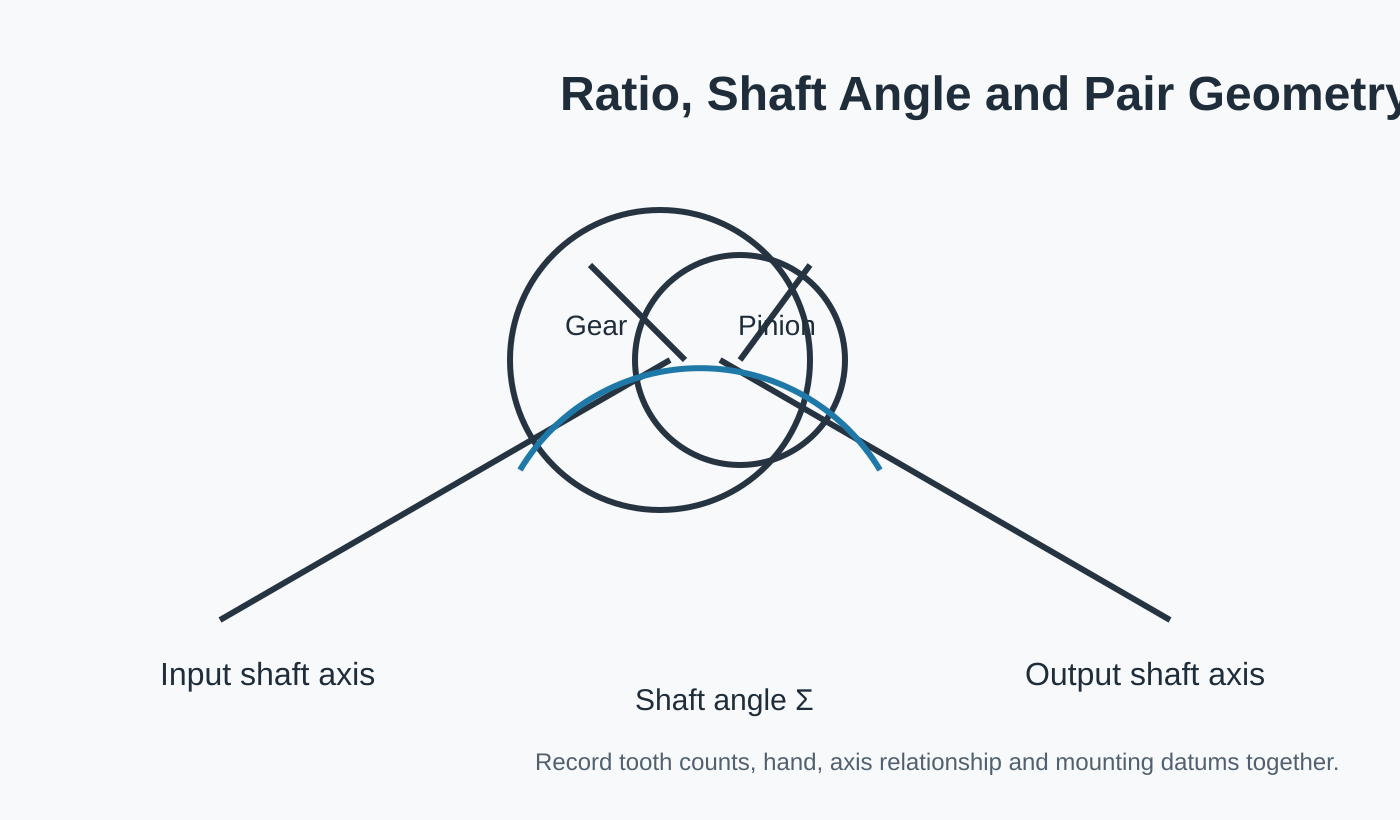
Identify both members, tooth counts or ratio, hand and which component drives.
Show the shaft angle, mounting references, bearing positions and any controlled backlash.
State the inspection or contact checks that matter to release the part for this machine.
| Review area | What to provide | Why it matters |
|---|---|---|
| Motion / duty | Acceleration/deceleration, cycle rate, backlash sensitivity, mounting stiffness, contamination control and lubrication | Separates steady power transmission from reversing, shock or position-sensitive duty. |
| Gear pair | Gear + pinion identity, ratio/tooth counts and hand | Prevents one component from being reviewed without its mating geometry. |
| Mounting | Shaft arrangement, bearing support, housing datums and target backlash | Connects the manufactured part to the position it will hold in the assembly. |
| Environment | Lubrication, temperature and contamination context | Supports practical material, finish and service review without inventing machine-level claims. |
| Inspection | Drawing tolerances, tooth finish and required records | Defines what the buyer will use to accept the ordered configuration. |
Dust, fines or process contamination can make lubrication and sealing decisions part of the application review. The gear quotation should not claim a protection level that belongs to the complete machine; instead, state the actual environment and the enclosure or lubrication plan.
Ground or custom sets can be reviewed for positioning-sensitive axes. A pinion shaft can be useful where the right-angle drive must fit into a compact bearing-supported layout.
If a laser-cutting or gantry drive still has open geometry or duty inputs, mark those items for review. An explicit unknown is safer than filling the drawing with an assumed standard value.
La sostituzione degli ingranaggi conici a spirale inizia separando le informazioni di progettazione originali dall'usura dovuta all'esercizio. Un dente danneggiato, un foro deformato o uno schema di contatto spostato possono descrivere il guasto, ma...
Visualizza la configurazione →
Una coppia di ingranaggi conici a spirale per impieghi gravosi deve essere valutata considerando l'intero ciclo operativo. Il carico di picco, il carico continuo, gli urti, le inversioni di marcia, il supporto dei cuscinetti e la lubrificazione sono tutti fattori rilevanti...
Visualizza la configurazione →
L'integrazione del pignone conico a spirale con un albero riduce i giunti separati, ma rende i perni dei cuscinetti, le spalle, le scanalature, le filettature e i riferimenti dei denti parte di un unico problema di produzione. Il…
Visualizza la configurazione →
Un set di ingranaggi a smusso elicoidale utilizza un numero uguale di denti per trasmettere il movimento tra alberi intersecanti senza modificare intenzionalmente il rapporto di velocità. Il rapporto uguale semplifica una parte della selezione...
Visualizza la configurazione →
La rettifica degli ingranaggi conici a spirale richiede più di una semplice operazione di rettifica su un ingranaggio normale. Lo schema di riferimento, la geometria di pre-rettifica, il trattamento termico, il sovrametallo di rettifica e l'ispezione finale sono...
Visualizza la configurazione →
Un set di ingranaggi conici a spirale personalizzato viene costruito in base alla geometria specifica del progetto piuttosto che a una tabella di standard pubblici. La definizione utile include entrambi i membri della coppia, l'asse...
Visualizza la configurazione →When the laser-cutting or gantry drive drawing controls material or heat treatment, include the exact requirement. If those choices remain open, describe the duty and leave material/process selection for review.
Photos of the laser-cutting or gantry drive help establish orientation and condition, but they do not define tooth geometry or mounting datums. Add the mating member, drawing data and measurements taken from controlled assembly references.
For the laser-cutting or gantry drive, send the assembly information that controls shaft relationship, mounting datums and interfaces. Unrelated machine details can be omitted when they have no effect on gear selection or inspection.
For the laser-cutting or gantry drive, separate prototype/sample quantity from expected repeat demand. This keeps tooling, inspection and production planning tied to the real purchasing stage.
Quanto più chiaramente vengono definiti i rapporti di accoppiamento e i riferimenti di assemblaggio, tanto più rapidamente la configurazione può essere verificata.
Il quantitativo minimo d'ordine (MOQ) è flessibile in base al tipo di prodotto, al processo produttivo e al valore totale dell'ordine. Per i nuovi progetti idonei, è possibile richiedere da 1 a 5 campioni a prezzi agevolati. È possibile combinare modelli diversi quando l'importo totale dell'ordine raggiunge circa 1.500 USD. Ordini di 1 o 2 pezzi possono essere valutati, sebbene il costo unitario sia generalmente più elevato.
I tempi di pianificazione tipici sono di 10-25 giorni lavorativi per i componenti standard, 20-45 giorni lavorativi per i componenti personalizzati e 45-120 giorni lavorativi per apparecchiature o assemblaggi di tipo progettuale. Sono generalmente supportati i termini EXW, FOB, CIF e DAP; per la spedizione è possibile concordare i termini FCA, CFR, CPT, CIP e DDP.