Machine duty
Explain ratio, torque and speed spectrum, bearing arrangement, housing stiffness, lubrication, service interval and replacement strategy. These inputs help the quotation reflect the actual machine rather than an industry label.
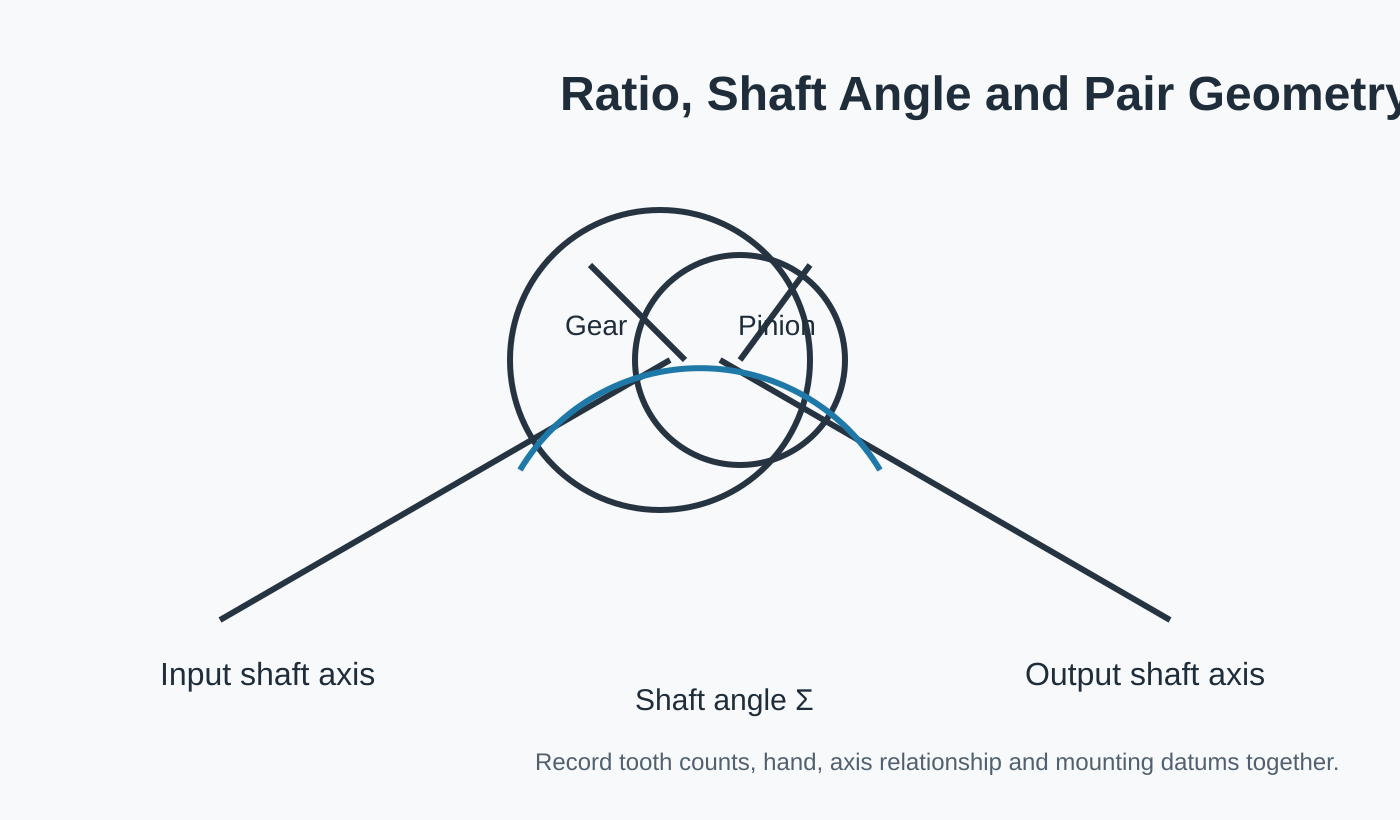
Industrial gearboxes use spiral bevel pairs to redirect power between intersecting shafts. Ratio, load, bearing layout, housing stiffness, lubrication and service strategy all belong in the review.

Inside a gearbox, the pair is tied to bearings, shafts, seals and a rigid housing. A strong RFQ shows the mounting references and states whether the new parts are for a fresh design, a planned redesign or replacement in an existing housing.
For new gearbox designs, provide the intended lubrication method and expected duty so tooth finishing and inspection can be reviewed in context. For MRO work, state whether the existing housing and bearings will remain unchanged.

| Review area | What to provide | Why it matters |
|---|---|---|
| Motion / duty | Ratio, torque and speed spectrum, bearing arrangement, housing stiffness, lubrication, service interval and replacement strategy | Separates steady power transmission from reversing, shock or position-sensitive duty. |
| Gear pair | Gear + pinion identity, ratio/tooth counts and hand | Prevents one component from being reviewed without its mating geometry. |
| Mounting | Shaft arrangement, bearing support, housing datums and target backlash | Connects the manufactured part to the position it will hold in the assembly. |
| Environment | Lubrication, temperature and contamination context | Supports practical material, finish and service review without inventing machine-level claims. |
| Inspection | Drawing tolerances, tooth finish and required records | Defines what the buyer will use to accept the ordered configuration. |
For replacement work, avoid assuming that a legacy part number fully defines the geometry. Product revisions, field modifications or unknown mating members can create risk. Where possible, combine the legacy reference with drawings, measurements and the actual mate.
Custom, ground, heavy-duty and replacement spiral bevel gear families can all apply depending on the gearbox duty and the quality of the existing design information.
If a industrial gearbox stage still has open geometry or duty inputs, mark those items for review. An explicit unknown is safer than filling the drawing with an assumed standard value.


Replacement spiral bevel gear work begins by separating original design information from service wear. A damaged tooth, distorted bore or shifted contact pattern can describe the failure, but…
View configuration →
A heavy-duty spiral bevel gear pair should be reviewed from the complete operating duty. Peak load, continuous load, shock events, reversals, bearing support and lubrication can all matter…
View configuration →
Integrating the spiral bevel pinion with a shaft reduces separate joints, but it makes bearing journals, shoulders, splines, threads and tooth datums part of one manufacturing problem. The…
View configuration →
A spiral miter gear set uses equal tooth counts to transmit motion between intersecting shafts without intentionally changing speed ratio. Equal ratio simplifies one part of the selection,…
View configuration →
Ground spiral bevel gears require more than adding a grinding operation to a normal gear. The datum scheme, pre-grind geometry, heat treatment, grinding allowance and final inspection have…
View configuration →
A custom spiral bevel gear set is built around project-specific geometry rather than a public stock table. The useful definition includes both members of the pair, the axis…
View configuration →When the industrial gearbox stage drawing controls material or heat treatment, include the exact requirement. If those choices remain open, describe the duty and leave material/process selection for review.
Photos of the industrial gearbox stage help establish orientation and condition, but they do not define tooth geometry or mounting datums. Add the mating member, drawing data and measurements taken from controlled assembly references.
For the industrial gearbox stage, send the assembly information that controls shaft relationship, mounting datums and interfaces. Unrelated machine details can be omitted when they have no effect on gear selection or inspection.
For the industrial gearbox stage, separate prototype/sample quantity from expected repeat demand. This keeps tooling, inspection and production planning tied to the real purchasing stage.
The more clearly the mating relationship and assembly datums are defined, the faster the configuration can be reviewed.
最小起订量 (MOQ) 根据产品类型、生产工艺和订单总额而定。合适的全新项目可以按样品价格索取 1-5 件样品。当订单总额达到约 1500 美元时,可以合并不同型号的产品。1-2 件的订单也可以考虑,但单价通常会更高。
标准件的典型计划周期为 10-25 个工作日,定制件为 20-45 个工作日,项目型设备或组件为 45-120 个工作日。通常支持 EXW、FOB、CIF 和 DAP 等贸易条款;FCA、CFR、CPT、CIP 和 DDP 等运输方式可另行商议。