Description
A spiral miter gear set uses equal tooth counts to transmit motion between intersecting shafts without intentionally changing speed ratio. Equal ratio simplifies one part of the selection, but the hand, shaft angle, mounting distance, interfaces and backlash still have to be defined.
Best starting point: A compact intersecting-axis direction change with approximately 1:1 ratio and a matched spiral bevel pair.
What this product family is designed to solve
Miter gears are often chosen for packaging and direction change. The gear set should be treated as a matched pair, especially when the assembly is sensitive to contact or lost motion.
Use a miter set when equal ratio is part of the design. If the ratio is not 1:1, or one member is integrated with a long shaft, use the custom or pinion-shaft product family instead.
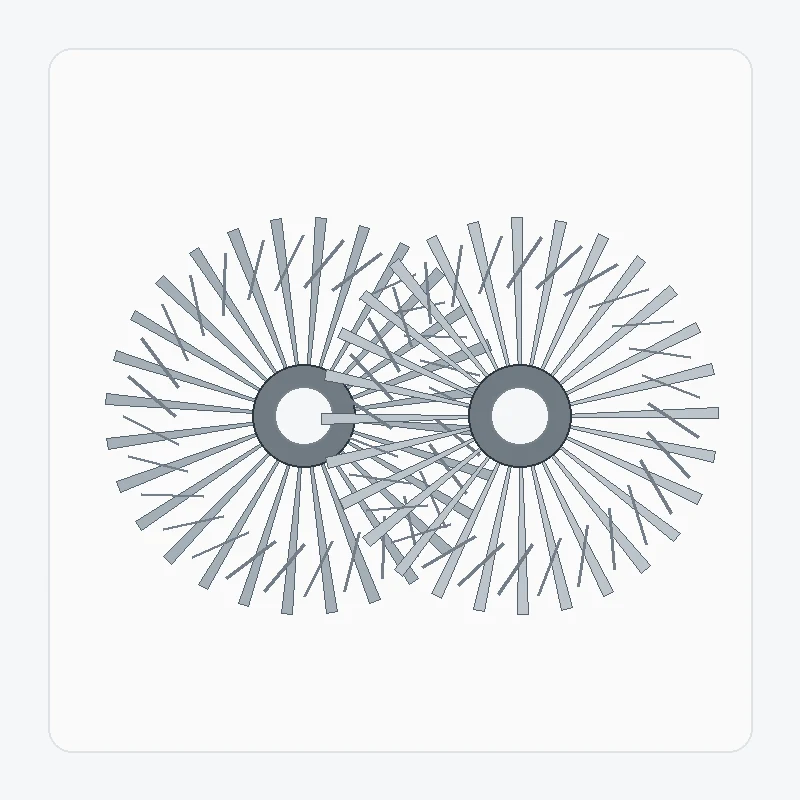
Specification and RFQ table
For spiral miter gear set, exact numerical values are confirmed for the ordered configuration. The table below identifies the drawing and enquiry fields that need explicit control.
| Selection item | Configuration | RFQ note |
|---|---|---|
| Pair identity | Matched spiral bevel gear pair or project-specific single component | Confirm the mating member and driving relationship. |
| Shaft angle | Project-specific | Show the axis relationship or assembly drawing. |
| Ratio / tooth counts | To drawing or RFQ | Provide both tooth counts when known. |
| Module / diametral pitch | To drawing or RFQ | Do not estimate from outside diameter alone. |
| Pressure angle | Confirm for ordered configuration | Use the drawing or reliable legacy data for replacement work. |
| Spiral angle & hand | Confirm for ordered configuration | Identify right/left hand with a defined viewing convention. |
| Mounting distance / backlash | Project-specific | Provide housing datums and target range when controlled. |
| Bore / spline / shaft interface | To drawing or sample | Include keyway, spline standard, journals and datum requirements. |
| Material / heat treatment | To drawing or project review | State mandatory grade, hardness or case requirements if controlled. |
| Tooth finish / quality | To drawing or project review | State cut/ground requirement and the acceptance standard or inspection criteria. |
A 1:1 ratio still needs a defined shaft relationship
The drawing should show both members, the shaft angle and the references that locate them. If the gears are integrated into hubs, shafts or flanges, those features must be tied to the tooth datums. Manufacturing and inspection then follow the ordered material and tooth-finish requirements.
The technical visual for spiral miter gear set is a discussion aid for component relationships. The controlled production drawing and approved quotation remain the dimensional definition for the order.
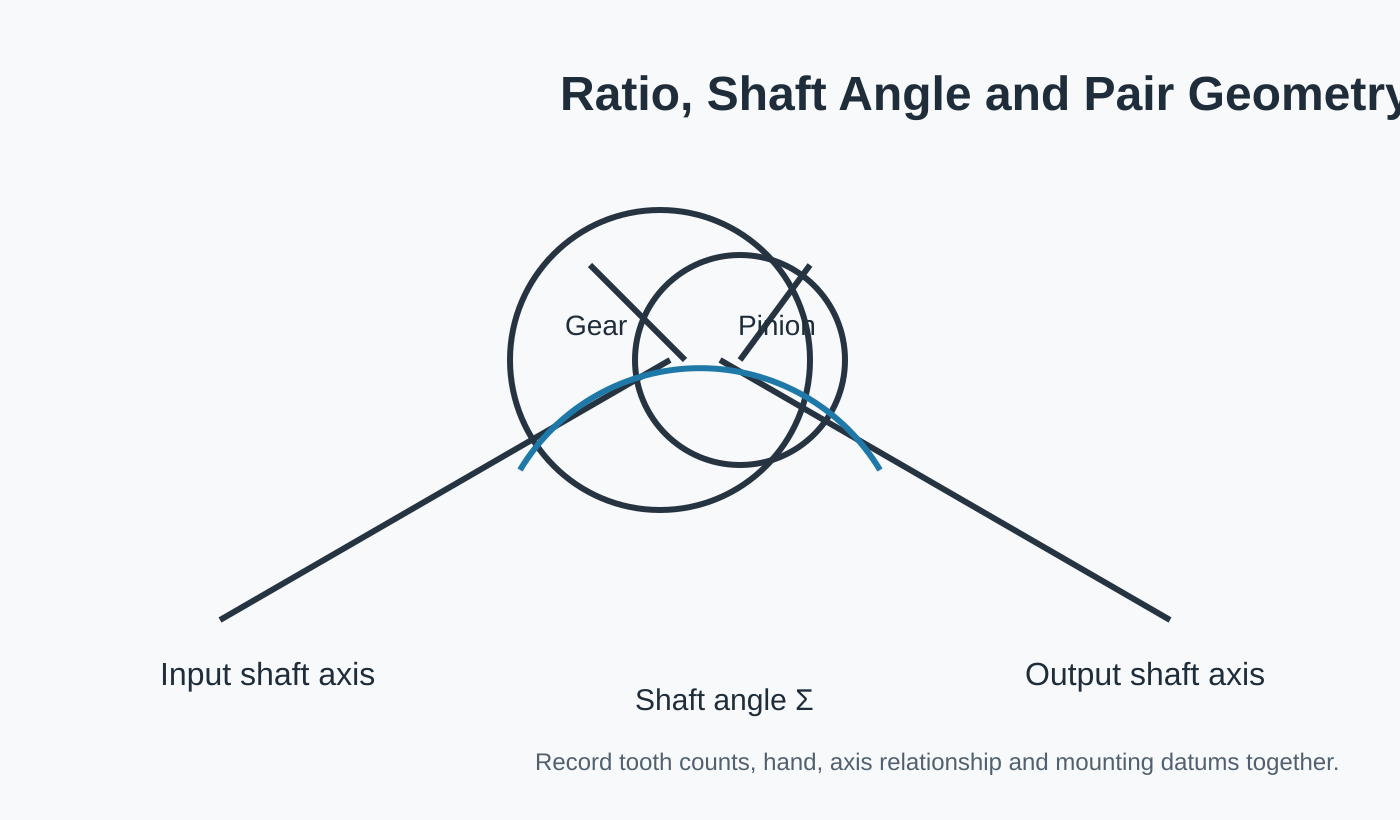
Interfaces and assembly checks

Mating member
Confirm which gear mates with the component and whether both members are included in the supply.

Datums & mounting
Show the surfaces and axes that control mounting distance, shaft position and backlash.

Material route
State controlled material/heat-treatment requirements and identify features that need secondary machining.

Acceptance
List the dimensional, tooth-quality, runout or contact checks that are required for release.
Typical application fit
Right-angle auxiliary drives, compact machine mechanisms, automation equipment and gearboxes where equal ratio and intersecting axes are required.
Application duty should be sent with the drawing whenever it can change the material route, tooth finishing, support assumptions or inspection requirement.
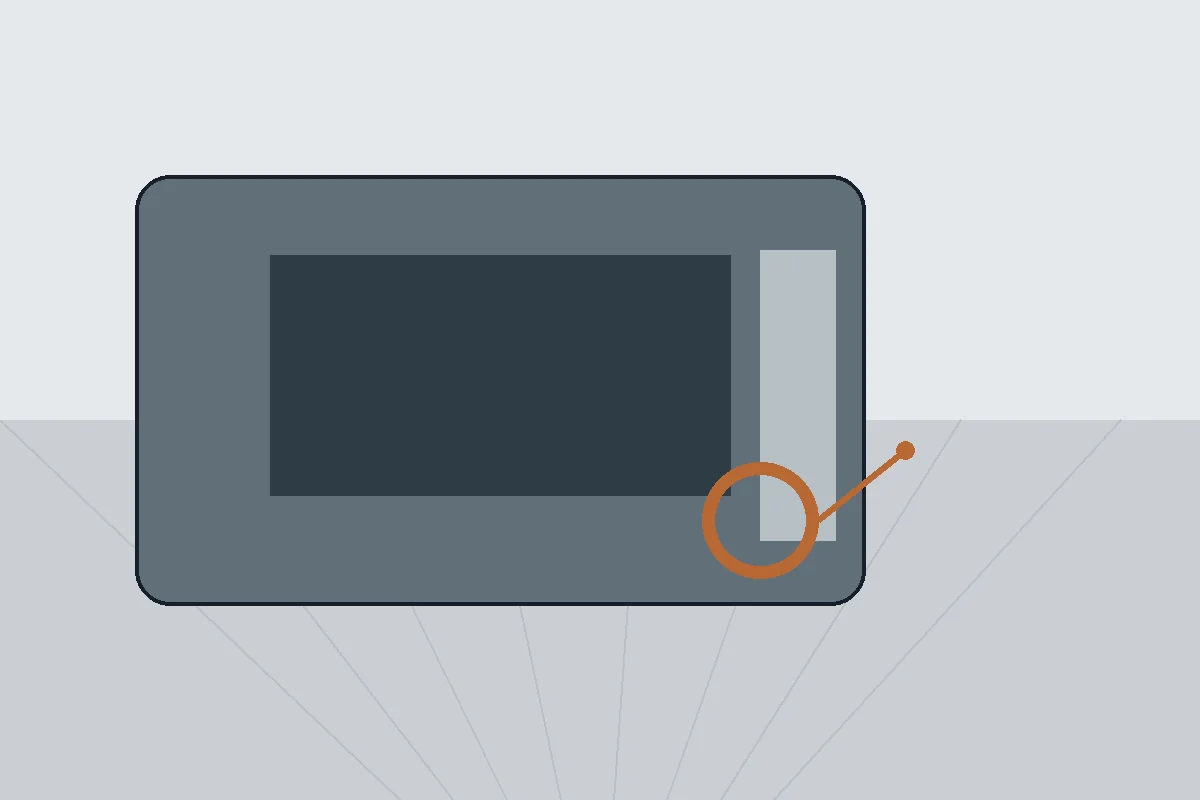
Machines-outils à commande numérique

Entraînements à angle droit et mécanismes de positionnement où la rigidité de montage et le jeu sont importants.
Guide de candidature →
Robotique et automatisation

Mécanismes compacts à axes sécants avec fonctions réversibles et exigences de répétabilité.
Guide de candidature →
Systèmes de découpe laser et de portique

Transmission à changement de direction autour des portiques et des équipements de positionnement automatisés.
Guide de candidature →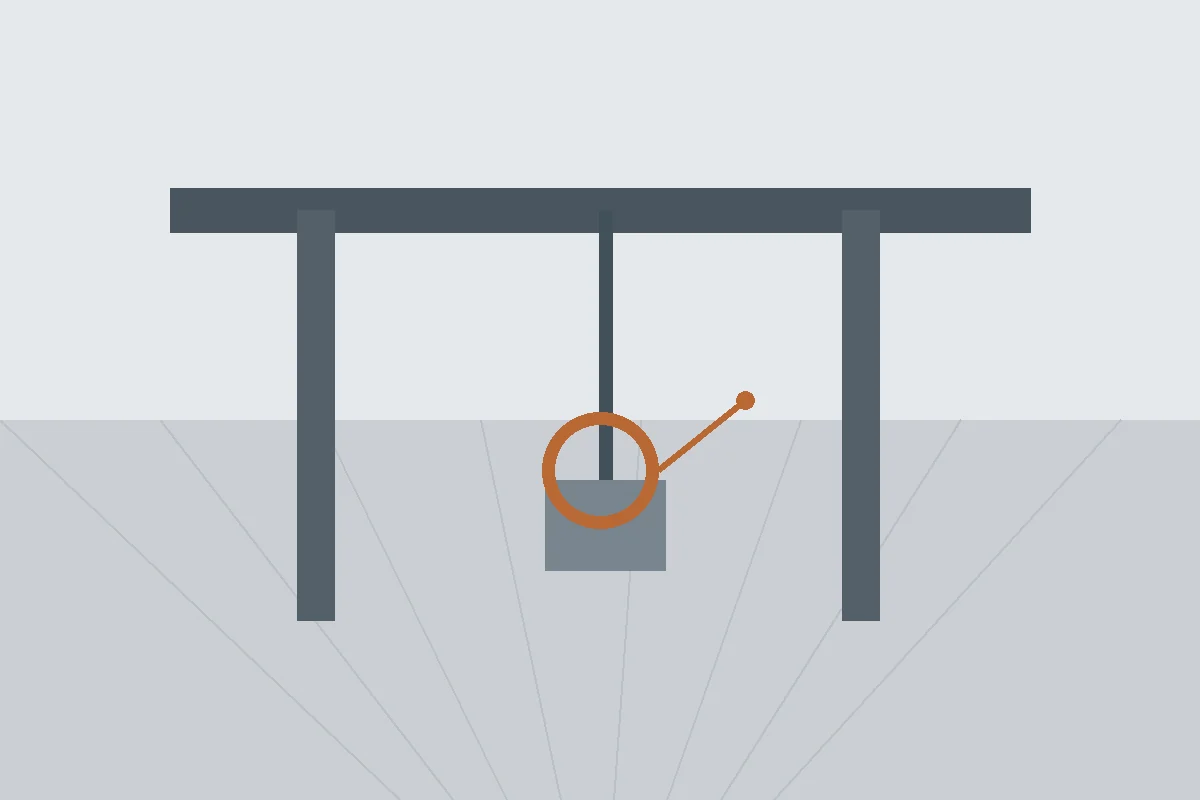
Levage de charges lourdes et palans

Mécanismes robustes nécessitant une révision des dispositifs de choc, de démarrage/arrêt et de support.
Guide de candidature →
Machines de précision

Systèmes de précision compacts avec références, faux-rond et exigences de contact contrôlés.
Guide de candidature →
Réducteurs industriels

Étages de boîte de vitesses qui acheminent le couple à travers des agencements d'arbres entrecroisés.
Guide de candidature →Manufacturing and inspection sequence
Review
Confirm drawing revision, pair identity, open questions and acceptance-critical features.
Plan
Define blank, datum machining, gear cutting, heat treatment and finish sequence.
Finish
Complete tooth and interface finishing according to the ordered route.
Inspect
Check the dimensions and gear-related criteria agreed for the configuration.
What to include in the enquiry
| RFQ group | Recommended detail |
|---|---|
| Technical definition | Current drawing, pair reference, ratio/tooth counts, hand and axis relationship |
| Assembly | Bore/shaft/spline, bearings, housing datums, mounting distance and backlash if controlled |
| Duty | Speed, torque/load spectrum, reversals, shock, environment and lubrication |
| Quality | Material, heat treatment, tooth finish, tolerances and inspection records |
| Commercial | Prototype and repeat quantity, destination, timing target and preferred trade term |
Frequently asked questions
Can I order only one member of the pair?
For spiral miter gear set, supplying one member can be reviewed when the mate is fully defined. If the existing mate is unknown, send its drawing, measurements or physical gear before releasing a single component.
Can a worn sample be copied directly?
A worn spiral miter gear set sample can support identification, but wear should not be treated as original geometry. Legacy drawings, an unused mating member and assembly measurements provide a stronger reconstruction basis.
Do I need to choose material and heat treatment before the RFQ?
When the spiral miter gear set design controls material or heat treatment, state the exact requirement. If those items are open, describe duty and mark them for selection review rather than borrowing a grade from another gear.
How are small sample quantities handled?
Small samples of spiral miter gear set can be reviewed for suitable new projects. Separate prototype quantity from expected repeat demand so setup, inspection and later production are planned against the correct volume.
Planification commerciale pour votre demande de devis
Pour toute demande de devis, la quantité minimale de commande (MOQ) est flexible et dépend du type de produit, du procédé de fabrication et du montant total de la commande. Les nouveaux projets peuvent être étudiés pour 1 à 5 échantillons à un prix préférentiel. Différents modèles peuvent être combinés lorsque le total de la commande atteint environ 1 500 USD. Les commandes de 1 à 2 pièces sont également envisageables, généralement à un coût unitaire plus élevé, car les frais de mise en place et de contrôle sont concentrés sur une très petite quantité.
Pour toute demande de devis, les délais de livraison sont généralement de 10 à 25 jours ouvrés pour les pièces standard, de 20 à 45 jours ouvrés pour les composants sur mesure et de 45 à 120 jours ouvrés pour les équipements ou assemblages spécifiques à un projet. Les incoterms EXW, FOB, CIF et DAP sont couramment proposés ; les incoterms FCA, CFR, CPT, CIP et DDP peuvent être discutés en fonction de l’expédition et de la destination.
Veuillez inclure la paire d'engrenages, le schéma et le descriptif du service dans une seule demande de devis.
Plus les relations d'accouplement et les données d'assemblage sont définies clairement, plus la configuration peut être examinée rapidement.
Conseils pour les commandes et la livraison
La quantité minimale de commande (MOQ) est flexible et dépend du type de produit, du procédé de fabrication et du montant total de la commande. Pour les nouveaux projets, il est possible de commander de 1 à 5 échantillons à un tarif préférentiel. Différents modèles peuvent être combinés lorsque le montant total de la commande atteint environ 1 500 USD. Les commandes de 1 à 2 pièces peuvent être étudiées, bien que le coût unitaire soit généralement plus élevé.
Les délais de planification habituels sont de 10 à 25 jours ouvrables pour les pièces standard, de 20 à 45 jours ouvrables pour les composants sur mesure et de 45 à 120 jours ouvrables pour les équipements ou assemblages spécifiques à un projet. Les incoterms EXW, FOB, CIF et DAP sont couramment pris en charge ; les incoterms FCA, CFR, CPT, CIP et DDP peuvent être envisagés pour l’expédition.