Description
La rectification des engrenages coniques à denture spirale exige bien plus qu'une simple opération de rectification. Le système de référence, la géométrie avant rectification, le traitement thermique, la surépaisseur de rectification et le contrôle final doivent être coordonnés afin d'obtenir un état de surface des dents conforme aux références stables.
Meilleur point de départ : Une paire appariée où la configuration commandée exige spécifiquement une finition de dent rectifiée, un contrôle plus strict de la finition de dent ou une procédure de finition post-traitement thermique coordonnée.
Ce que cette gamme de produits est conçue pour résoudre
La mise à la terre est surtout utile lorsqu'elle correspond à un dessin ou à une exigence de performance réelle. Elle ne doit pas être choisie uniquement parce que le terme « mise à la terre » sonne bien ; le reste de l'assemblage doit pouvoir maintenir la paire dans la position de montage prévue.
Comparativement à un jeu de dents taillées, la séquence de fabrication et le plan d'inspection nécessitent généralement un contrôle plus rigoureux après traitement thermique. Par rapport à un jeu sur mesure standard, la configuration rectifiée restreint le choix des procédés, mais ne dispense pas de définir la géométrie des paires.

Tableau des spécifications et des demandes de prix
Pour les engrenages coniques hélicoïdaux rectifiés, les valeurs numériques exactes sont confirmées pour la configuration commandée. Le tableau ci-dessous indique les champs du dessin et de la demande de renseignements qui nécessitent un contrôle précis.
| Élément de sélection | Configuration | Note de demande de prix |
|---|---|---|
| Identité de paire | Paire d'engrenages coniques à denture hélicoïdale appariée ou composant unique spécifique au projet | Confirmer le membre reproducteur et la relation de conduite. |
| angle de l'arbre | Spécifique au projet | Afficher le schéma des axes ou le dessin d'assemblage. |
| Rapport / nombre de dents | Pour le dessin ou la demande de devis | Indiquez le nombre de dents pour les deux dents lorsqu'il est connu. |
| Pas du module / diamétral | Pour le dessin ou la demande de devis | Ne pas estimer uniquement à partir du diamètre extérieur. |
| Angle de pression | Confirmer la configuration commandée | Utilisez le dessin ou des données historiques fiables pour les travaux de remplacement. |
| Angle spiral et main | Confirmer la configuration commandée | Identifier la main droite/gauche selon une convention de vision définie. |
| Distance de montage / jeu | Spécifique au projet | Fournir les données de référence du logement et la portée cible lorsque le contrôle est assuré. |
| Interface alésage/cannelure/arbre | Pour un dessin ou un échantillon | Inclure les exigences relatives aux rainures de clavette, aux cannelures standard, aux tourillons et aux références. |
| Traitement thermique des matériaux | Examen de dessin ou de projet | Indiquer les exigences obligatoires en matière de nuance, de dureté ou de boîtier, le cas échéant. |
| Finition/qualité des dents | Examen de dessin ou de projet | Exigences de coupe/nivellement de l'État et normes d'acceptation ou critères d'inspection. |
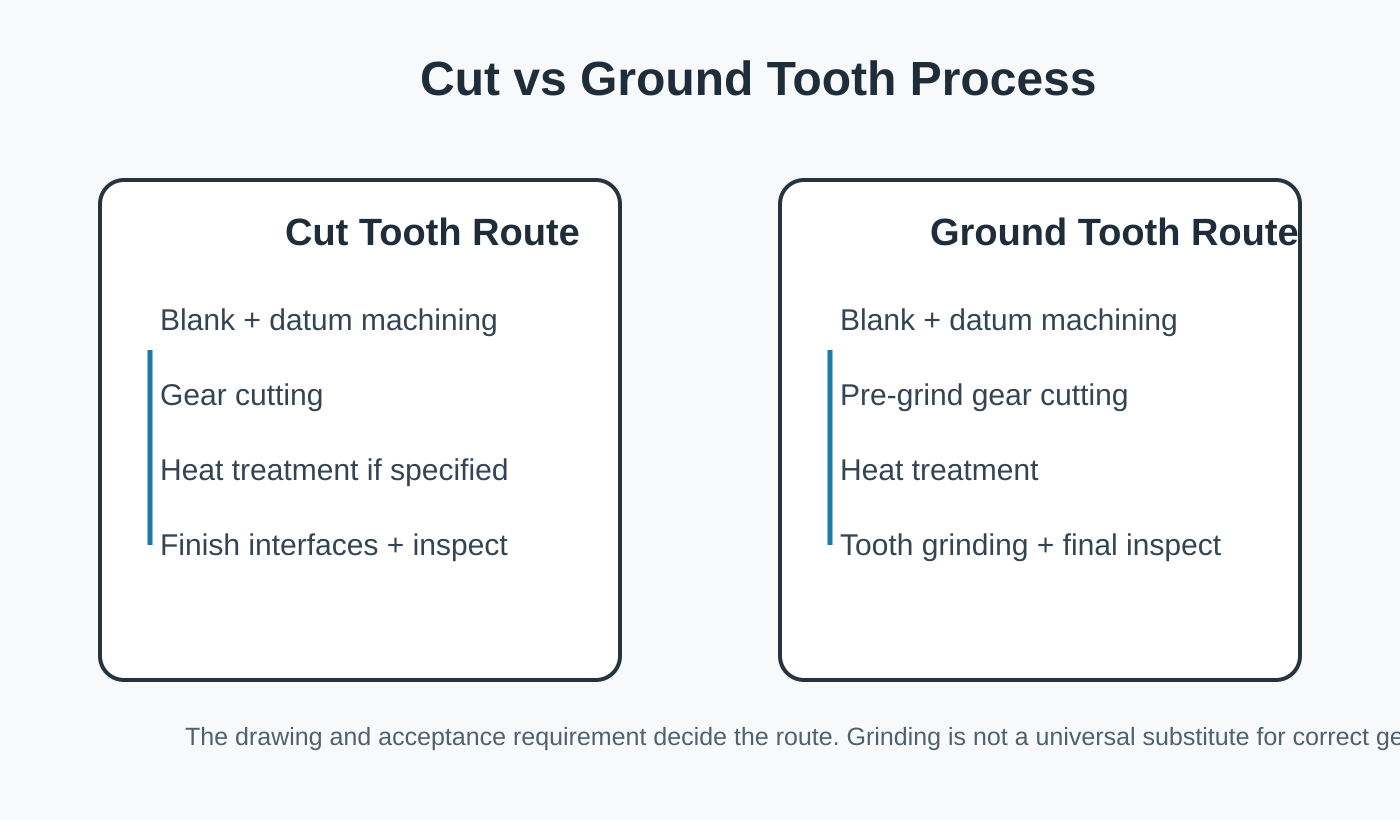
Le processus de fabrication change avant la finition finale de la dent.
Le processus typique consiste à définir les surfaces d'ébauche et de référence, à usiner la roue dentée selon les dimensions prévues, à appliquer le traitement thermique spécifié, puis à finir la surface de la dent par rectification. Les opérations de finition et le contrôle doivent respecter les surfaces utilisées pour le positionnement de la roue dentée lors de la rectification.
Le schéma technique de l'engrenage conique à denture hélicoïdale rectifiée sert d'aide à la discussion concernant les relations entre les composants. Le plan de production validé et le devis approuvé constituent la définition dimensionnelle de la commande.
Interfaces et vérifications d'assemblage

Membre reproducteur
Vérifiez quel engrenage est compatible avec le composant et si les deux éléments sont inclus dans la fourniture.

Données de référence et montage
Afficher les surfaces et les axes qui contrôlent la distance de montage, la position de l'arbre et le jeu.

Route des matériaux
Définir les exigences relatives aux matériaux et aux traitements thermiques contrôlés par l'État et identifier les caractéristiques nécessitant un usinage secondaire.

Acceptation
Énumérer les contrôles dimensionnels, de qualité des dents, de faux-rond ou de contact requis pour la mise en service.
Adaptation typique à l'application
Machines de précision, entraînements de machines-outils sélectionnés, réducteurs industriels à commande numérique et autres ensembles pour lesquels le dessin exige une finition de dent rectifiée ou un niveau de qualité de finition défini.
Le dossier d'application doit être joint au dessin chaque fois qu'il est susceptible de modifier le cheminement du matériau, la finition des dents, les hypothèses de support ou les exigences d'inspection.
Machines-outils à commande numérique

Entraînements à angle droit et mécanismes de positionnement où la rigidité de montage et le jeu sont importants.
Guide de candidature →
Robotique et automatisation

Mécanismes compacts à axes sécants avec fonctions réversibles et exigences de répétabilité.
Guide de candidature →
Systèmes de découpe laser et de portique

Transmission à changement de direction autour des portiques et des équipements de positionnement automatisés.
Guide de candidature →
Levage de charges lourdes et palans

Mécanismes robustes nécessitant une révision des dispositifs de choc, de démarrage/arrêt et de support.
Guide de candidature →
Machines de précision

Systèmes de précision compacts avec références, faux-rond et exigences de contact contrôlés.
Guide de candidature →
Réducteurs industriels

Étages de boîte de vitesses qui acheminent le couple à travers des agencements d'arbres entrecroisés.
Guide de candidature →séquence de fabrication et d'inspection
Revoir
Confirmer la révision du dessin, l'identité de la paire, les questions ouvertes et les caractéristiques critiques pour l'acceptation.
Plan
Définir la séquence d'ébauche, d'usinage de référence, de taillage d'engrenages, de traitement thermique et de finition.
Finition
Finition complète des dents et des interfaces selon le parcours prescrit.
Inspecter
Vérifiez les dimensions et les critères relatifs à l'engrenage convenus pour la configuration.
Que faut-il inclure dans la demande ?
| Groupe RFQ | Détails recommandés |
|---|---|
| Définition technique | Dessin actuel, référence de paire, rapport/nombre de dents, relation main-axe |
| Assemblée | Alésage/arbre/cannelure, roulements, références du carter, distance de montage et jeu (si contrôlé) |
| Devoir | Vitesse, spectre couple/charge, inversions de sens, chocs, environnement et lubrification |
| Qualité | Matériaux, traitement thermique, finition des dents, tolérances et rapports d'inspection |
| Commercial | Quantité du prototype et de la répétabilité, destination, échéancier cible et conditions commerciales préférées |
Foire aux questions
Puis-je commander un seul membre de la paire ?
Pour les engrenages coniques à denture hélicoïdale rectifiée, la fourniture d'un seul élément peut être envisagée une fois l'accouplement entièrement défini. Si l'accouplement existant est inconnu, veuillez fournir son dessin, ses dimensions ou un échantillon physique de la dent avant de livrer un seul composant.
Peut-on copier directement un échantillon usé ?
Un échantillon d'engrenage conique à denture hélicoïdale usé peut faciliter l'identification, mais l'usure ne doit pas être considérée comme la géométrie d'origine. Les plans d'époque, une pièce d'accouplement neuve et les mesures d'assemblage constituent une base de reconstitution plus solide.
Dois-je choisir le matériau et le traitement thermique avant la demande de devis ?
Lorsque la conception de l'engrenage conique rectifié impose des contraintes sur le matériau ou le traitement thermique, précisez les exigences exactes. Si ces exigences sont variables, décrivez leur utilisation et indiquez-les pour une sélection plus poussée, plutôt que de reprendre les caractéristiques d'un autre engrenage.
Comment gère-t-on les petits échantillons ?
De petits échantillons d'engrenages coniques rectifiés peuvent être analysés afin d'identifier les projets potentiels. Il est important de distinguer la quantité de prototypes de la demande de production ultérieure prévue afin d'adapter la mise en place, le contrôle qualité et la production ultérieure au volume adéquat.
Planification commerciale pour votre demande de devis
Pour toute demande de devis, la quantité minimale de commande (MOQ) est flexible et dépend du type de produit, du procédé de fabrication et du montant total de la commande. Les nouveaux projets peuvent être étudiés pour 1 à 5 échantillons à un prix préférentiel. Différents modèles peuvent être combinés lorsque le total de la commande atteint environ 1 500 USD. Les commandes de 1 à 2 pièces sont également envisageables, généralement à un coût unitaire plus élevé, car les frais de mise en place et de contrôle sont concentrés sur une très petite quantité.
Pour toute demande de devis, les délais de livraison sont généralement de 10 à 25 jours ouvrés pour les pièces standard, de 20 à 45 jours ouvrés pour les composants sur mesure et de 45 à 120 jours ouvrés pour les équipements ou assemblages spécifiques à un projet. Les incoterms EXW, FOB, CIF et DAP sont couramment proposés ; les incoterms FCA, CFR, CPT, CIP et DDP peuvent être discutés en fonction de l’expédition et de la destination.
Veuillez inclure la paire d'engrenages, le schéma et le descriptif du service dans une seule demande de devis.
Plus les relations d'accouplement et les données d'assemblage sont définies clairement, plus la configuration peut être examinée rapidement.
Conseils pour les commandes et la livraison
La quantité minimale de commande (MOQ) est flexible et dépend du type de produit, du procédé de fabrication et du montant total de la commande. Pour les nouveaux projets, il est possible de commander de 1 à 5 échantillons à un tarif préférentiel. Différents modèles peuvent être combinés lorsque le montant total de la commande atteint environ 1 500 USD. Les commandes de 1 à 2 pièces peuvent être étudiées, bien que le coût unitaire soit généralement plus élevé.
Les délais de planification habituels sont de 10 à 25 jours ouvrables pour les pièces standard, de 20 à 45 jours ouvrables pour les composants sur mesure et de 45 à 120 jours ouvrables pour les équipements ou assemblages spécifiques à un projet. Les incoterms EXW, FOB, CIF et DAP sont couramment pris en charge ; les incoterms FCA, CFR, CPT, CIP et DDP peuvent être envisagés pour l’expédition.